When fuel prices spike, criminals go to work. Are your protected?
The conflict in the Middle East is hitting European businesses in the wallet — hard. Since the outbreak of the Israel-Iran war, global diesel prices have surged, with European benchmark gasoil up nearly the same margin in a matter of weeks. In Belgium, diesel currently stands at €2,019/l. In the Netherlands, the national advisory price briefly broke the historic €2.50/l mark — up from €2.09 before the conflict began.
Most businesses are rightly focused on what this means for their operating costs. But there's a threat that doesn't show up in your energy budget — and it's growing just as fast as the price per litre.
When the value of fuel goes up, so does the motivation to steal it.
Fuel on your construction site is a walking cash machine
A standard medium-duty generator used on construction sites holds between 400 and 800 litres of diesel in its base tank. Larger units can carry well over 1,000 litres.
Do the maths. At today's Belgian pump price, a single full tank represents €780 to €1,940 in fuel alone. A professional fuel theft gang can drain that tank completely in under 20 minutes using portable pumps.
Same goes for excavators, dump trucks and cranes: these machines all have fuel tanks filled with a significant amount of diesel/fuel.
They hit multiple sites in a single night. No alarm went off. No one saw anything. The damage is only discovered Monday morning when your site manager tries to fire up the generator or machine.
According to CIOB research cited in 2025, 51% of construction sites experienced fuel theft in the previous year.
The financial damage doesn't stop at the value of the stolen fuel either. A dead generator or machine means a halted site, delayed trades, and frustrated clients — costs that dwarf the price of the diesel itself.
Bus depots and truck stations: sitting ducks overnight
The problem extends far beyond construction sites. Anywhere diesel sits unguarded overnight is a target.
Bus operators and logistics companies that park their fleets at overnight depots are increasingly finding vehicles drained by morning. A single long-haul truck carries 400 to 700 litres of diesel in its tank. A bus depot with 30 vehicles parked overnight represents tens of thousands of euros in fuel — all accessible, all exposed.
According to the Transported Asset Protection Association (TAPA), cargo and fuel theft in Europe costs businesses an estimated €8.2 billion annually. When it comes to trucks specifically, fuel theft from tanks is consistently reported as the most common form of theft during overnight stops — ahead of cargo theft itself.
The rising fuel price has made this arithmetic even more attractive for criminals. What was once a low-reward opportunistic crime has become an organised, high-yield operation — complete with tanker vehicles, industrial pumps, and coordinated lookouts.
It's not just fuel. The supply chain follows.
The Middle East conflict hasn't only disrupted oil markets. It has fundamentally shaken global supply chains.
Shipping costs have surged. Lead times for materials have stretched from weeks to months. And prices for everything from radiators and boilers to copper piping, heat pumps, and water installation components are rising rapidly — and unpredictably. What you couldn't get last month, you still can't get this month. What you can get, costs significantly more than when you signed the contract.
And therein lies the second, often-overlooked threat: the theft of installed or stored materials is no longer just a financial nuisance. It is now potentially a project-delaying event.
When materials are stolen from a site today, the contractor cannot simply call the supplier and get a replacement next week. Lead times are uncertain. Prices have changed. And in the worst case — you're waiting months for a product that now costs 30%fmore than the original quote.
Most construction contracts are fixed-price agreements, negotiated and signed months — sometimes over a year — before a project breaks ground. The price was calculated on the basis of material costs, fuel costs, and supply timelines as they existed before the current wave of instability.
Today, those assumptions no longer hold. Material prices are up. Diesel is up. Replacement times are unpredictable. And theft of materials — already a growing problem — has become exponentially more disruptive because the items stolen simply cannot be quickly or cheaply replaced.
The solution is more accessible than you think
We understand why many project managers and site directors still hesitate when the topic of temporary security comes up. The assumption is that it's expensive, complex to deploy, and only justified for the largest sites.
That assumption is wrong
The cost of deploying temporary security —with our monitored camera towers — is a fraction of what a single serious theft incident costs in direct losses, project delays, insurance claims, and damaged client relationships.
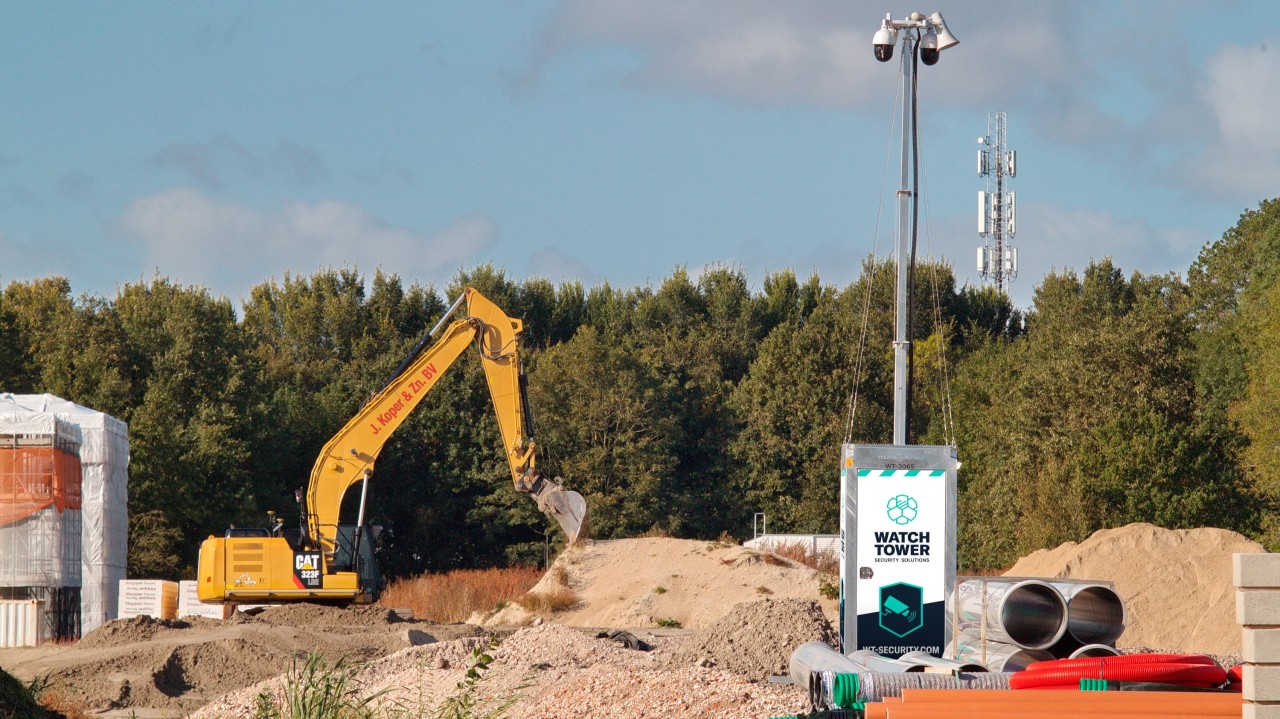
A monitored mobile security tower can be deployed on-site within hours, requires no infrastructure, and provides 24/7 deterrence and real-time incident response at a cost that is easily offset by preventing even one significant theft.
The Watchtower Security-solution
At Watchtower Security Solutions, we specialize in exactly this: protecting sites, depots, and assets that are temporarily exposed — with fast-deploy, flexible security solutions across Belgium, the Netherlands, Germany, and the UK.
Don't wait for the first incident to make the call.
Reach out to our team at Watchtower Security Solutions or connect with me directly — I'm happy to discuss what a smart, cost-effective security approach looks like for your site or portfolio.